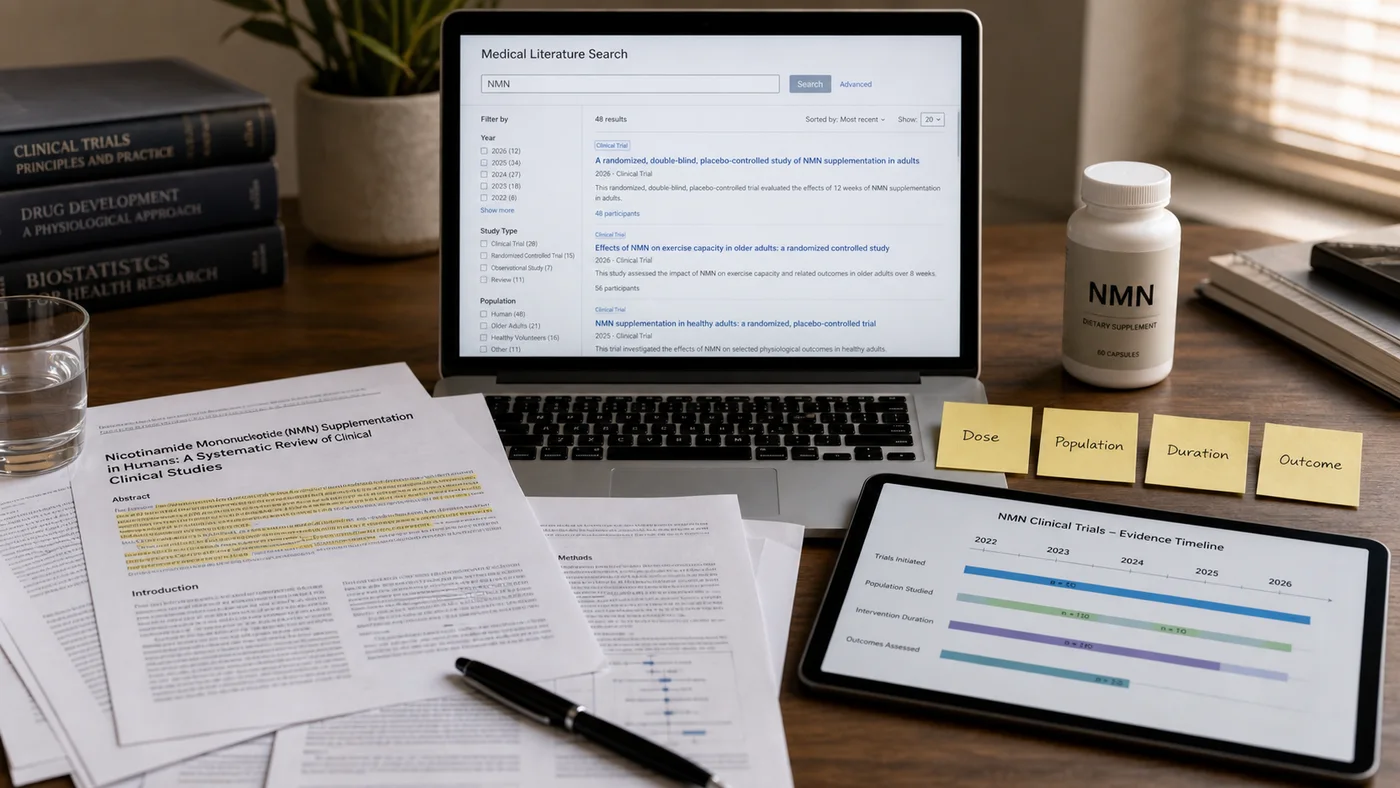
Six years of human NMN data, audited
The NMN field crossed from animal-only into human clinical territory in 2020. Six years on, we have roughly ten published randomised or controlled human trials and a larger pool of pharmacokinetic and observational studies.
This article audits the corpus as it stands in April 2026 - what the trials measured, what they found, what holds up, and what remains unproven.
The honest summary up front: NMN is safe at the doses studied, raises NAD+ in human tissue as the mechanism predicts, and shows modest signals on multiple biomarkers across small short-duration trials. It does not yet have a longevity-endpoint trial that proves the molecule reduces mortality or major disease incidence.
For a Malaysian buyer, that means evidence-aligned use sits in the discretionary supportive-supplement category, not the proven-treatment category.
Yoshino et al. 2021 (Science) - the breakthrough Western trial
A team led by first author Mihoko Yoshino, with senior investigators Shin-ichiro Imai and Samuel Klein at Washington University in St. Louis, reported the first major Western randomised trial of NMN in 2021, published in Science.
Twenty-five postmenopausal women with prediabetes received 250mg/day NMN or placebo for 10 weeks. The primary outcome was muscle insulin sensitivity, measured by hyperinsulinemic-euglycemic clamp.
The NMN group showed a statistically significant improvement in muscle insulin sensitivity (~25% increase from baseline) compared to placebo. Other metabolic markers showed trends but did not all reach significance. NAD+ levels rose in muscle tissue. No serious adverse events.
Why it matters: First high-profile Western trial in Science legitimised the field. Insulin sensitivity is a meaningful metabolic marker. Effect size was real but modest. Sample size was small (25 total).
Caveats: Single-centre, single-population (postmenopausal women with prediabetes), short duration (10 weeks). Replication in other populations is needed; this is hypothesis-supporting, not yet confirmatory.
Igarashi et al. 2022 (npj Aging) - the older-men physical-performance trial
Igarashi and colleagues studied 42 healthy Japanese men aged 65 and above, randomised to 250mg/day NMN (morning or afternoon dose) or placebo for 12 weeks. Primary outcomes included grip strength, gait speed, and 5-time chair-stand test.
The morning-dose NMN arm showed statistically significant improvement in walking speed (4-metre gait speed) and a positive trend in grip strength compared to placebo. The afternoon-dose arm showed less consistent benefit, suggesting dose timing matters and aligns with circadian NAD+ peak. No serious adverse events.
Why it matters: Established the morning-dose principle that has shaped consumer protocols since publication. Real physical-performance signal in the population most likely to benefit (older adults). Sample size small (42).
Caveats: Single-centre Japanese male population. Effect size modest. Industry-disclosed funding.
Kim et al. 2022 - sleep quality and fatigue
Kim and colleagues examined 12 weeks of 250mg/day NMN in older Japanese adults, tracking sleep quality, fatigue, and physical-performance measures. The trial reported modest improvements in sleep quality and fatigue-related outcomes compared with placebo, alongside physical-performance signals.
Why it matters: Sleep and fatigue are practical outcomes older adults actually notice. But this is one small trial reporting some sleep and fatigue improvements; the wider evidence on NMN and sleep is mixed, so treat it as a preliminary signal rather than a sleep-treatment claim.
Caveats: Small sample, short duration. Sleep is heavily influenced by behavioural factors; supplements operate at the margin.
Liao et al. 2021 - exercise performance in amateur runners
Liao et al. randomised amateur middle-aged runners to 300, 600, or 1,200 mg/day NMN over 6 weeks alongside exercise training. Ventilatory and aerobic thresholds improved in a dose-dependent fashion, but VO2 max itself did not change significantly between groups.
Why it matters: Aerobic threshold is a meaningful exercise-performance marker, and the dose-dependent pattern is worth exploring - though this is a fitness signal in trained runners, not evidence of any NMN-to-longevity link.
Caveats: Highly motivated, athletic population - generalisability to sedentary older adults is uncertain. Short duration.
Pencina et al. 2023 - MIB-626 pharmacokinetics
Pencina and colleagues (2023) studied MIB-626, a proprietary microcrystalline form of β-NMN being developed as a drug, in dosing/pharmacokinetic work. The formulation raised circulating NAD+ and related metabolites dose-dependently, with an acceptable short-term safety profile.
Why it matters: Confirms an oral β-NMN preparation can move NAD+ in humans. It is one of the more rigorous pharmacokinetic datasets available.
Caveats: MIB-626 is a proprietary microcrystalline drug formulation; its absorption and dosing do not transfer 1:1 to generic over-the-counter NMN. It is a pharmacokinetic study, not a clinical-outcome trial - it tells us NAD+ rises, not whether tissue-level effects or hard outcomes follow.
NMN and skin - no human supplement RCT yet
There is no published randomised controlled trial of oral NMN supplementation for human skin parameters. Any oral-NMN skin benefit remains unproven in humans, and marketing that implies a “clinically proven” skin effect from swallowed NMN is overstating the evidence.
What’s missing - the large-scale longevity trial
The conspicuous absence in the NMN trial corpus is the large, long-duration, hard-endpoint study. There is no NMN equivalent of the Mediterranean diet PREDIMED trial, the statin key trials, or the metformin TAME study (the latter ongoing for diabetes-aging endpoint).
Several registered trials are in progress and may report in 2026-2028:
- The MIND-NAD trial in healthy older adults (cognitive endpoints).
- Cardiovascular endpoint trials in metabolic syndrome populations.
- A Mayo Clinic-led study examining NMN in age-related metabolic decline.
Until these complete, the responsible framing of NMN evidence remains: mechanism plausible, safety reassuring at studied doses, surrogate biomarkers modestly improved, hard outcomes unknown.
What this means for Malaysian buyers
For a Malaysian considering NMN as a longevity-supportive supplement in 2026, the evidence base supports:
Defensible: 250mg morning dose for adults over 50 looking to support metabolic and physical-performance markers, with realistic expectations of small effect sizes.
Reasonable: 250-500mg dose for those with specific concerns (sleep, exercise capacity, post-menopausal metabolic shifts) where small published signals exist.
Speculative: Higher doses (>600mg) for general use beyond pharmacokinetic optimisation; the clinical-benefit case is thin.
Unsupported: Any longevity, lifespan, or disease-prevention claim. The trials are not there yet.
The evidence base will likely strengthen meaningfully over the next 2-3 years as registered trials report. We will revise this audit as new data publish.
How to weigh surrogate endpoints
The biggest trap in NMN interpretation is treating every positive biomarker as if it were a clinical outcome. A rise in NAD+ is a mechanism marker. Better insulin sensitivity is a risk-marker change. Faster gait speed is closer to a functional outcome.
Fewer hospitalisations, fewer cardiovascular events, lower dementia incidence, or longer survival would be hard outcomes. The NMN field has the first three categories, not the last one.
That distinction does not make the evidence useless. Early supplement evidence often starts with safety, pharmacokinetics, and small functional readouts before larger trials are funded. But it does mean Malaysian content should avoid turning trial language into product promises.
A page can fairly say “NMN has been shown to raise NAD+ and has modest signals in small human trials.” It should not say “NMN is proven to reverse aging” or “NMN prevents diabetes” because the trial designs do not support that wording.
Population fit is the second filter. Yoshino studied postmenopausal women with prediabetes. Igarashi studied older Japanese men. Kim focused on older adults, sleep quality, fatigue, and physical performance. Liao studied amateur runners.
A healthy 32-year-old office worker in Kuala Lumpur is not automatically represented by any of those groups. The closer your profile is to a trial population, the more weight that trial should carry. The farther away you are, the more the result becomes hypothesis, not direct guidance.
Dose fit is the third filter. Much of the consumer market jumps quickly to 500 mg or 1 g because higher numbers feel more serious. The cleaner published signals are often at 250 mg.
Pencina’s pharmacokinetic work on the proprietary MIB-626 formulation supports a dose-response rise in NAD+ markers, but a higher biomarker rise does not automatically mean better sleep, stronger muscles, or lower disease risk. That is why a cautious buying guide starts low, tracks response, and waits before increasing.
For Malaysia, regulatory fit is the fourth filter. Published trial evidence does not replace product verification. Before buying, compare the trial dose with the actual capsule dose, check the MAL or NPRA registration status where applicable, ask for batch COA, and inspect capsule material if halal status matters.
The NPRA stance guide, NMN + TMG evidence page, and Sinclair update are useful companions because they separate clinical evidence, regulatory reality, and influencer-driven expectations.
What would change the verdict
The verdict would become stronger if three types of trials arrive. First, a large multi-centre RCT in older adults using pre-registered functional outcomes such as gait speed, frailty score, VO2 max, or insulin clamp endpoints. Second, a long-duration metabolic trial with enough participants to detect meaningful changes in diabetes progression, cardiovascular markers, or medication use.
Third, independent replication across non-Japanese, non-US, and Southeast Asian populations, because diet, baseline health, genetics, and supplement access differ across regions.
Until then, the responsible Malaysian position is balanced. NMN is one of the more interesting supplement molecules in aging biology. It has a better human evidence base than many anti-aging products sold online. It also remains far short of a proven disease-prevention or life-extension intervention.
Buyers should treat it as an optional, evidence-informed supplement experiment, not as medical therapy and not as a substitute for sleep, training, diet, blood pressure control, or professional care.
Trial-by-trial buyer interpretation
Yoshino 2021 is most relevant to buyers who resemble the study group: postmenopausal women with impaired glucose handling. For them, the insulin-sensitivity signal is worth discussing with a clinician, especially if lifestyle work and metabolic monitoring are already in place. It is less directly relevant to young healthy men, athletes, or people buying NMN mainly for skin and energy.
Igarashi 2022 is most relevant to older adults who care about walking speed, grip strength, and maintaining independence. The morning-dose result is useful because it gives a practical timing cue. It does not prove NMN builds muscle by itself. Resistance training, protein intake, vitamin D status, and sleep still sit upstream of any supplement decision.
Kim 2022 is most relevant to older adults with sleep-quality or fatigue concerns. It supports the idea that NAD+ biology touches circadian and energy regulation, but sleep outcomes are easy to distort with caffeine, screen time, alcohol, stress, and room temperature. Malaysian readers should fix those basics before attributing every sleep change to NMN.
Liao 2021 is most relevant to trained or semi-trained adults because amateur runners are not the same as sedentary beginners. If a buyer exercises regularly and wants to test aerobic recovery, NMN has a plausible trial signal. If the buyer is not exercising, the study does not convert NMN into a shortcut for fitness.
Pencina’s pharmacokinetic work is relevant because it tells us that an oral β-NMN preparation can raise NAD+ related markers in a dose-responsive way - though it tested MIB-626, a proprietary microcrystalline drug formulation, so the numbers do not transfer 1:1 to a generic OTC capsule.
It is also the study type most often overused in marketing. Pharmacokinetics answer “does it move the biomarker?” not “does it change disease risk?” A buyer should treat it as necessary evidence, not sufficient evidence.
Skin-focused interest is common among consumers who buy anti-aging supplements for visible appearance, but there is no human supplement RCT for oral NMN and skin, so any skin benefit is unproven.
Skin changes are affected by sunscreen, retinoids, sleep, menopause, smoking, hydration, and weight change. NMN, at best, may sit in the background - not at the centre - and claims of a proven skin effect from swallowed NMN are unsupported.
The buyer conclusion is not that one trial wins the whole debate. The conclusion is to match your reason for buying to the trial closest to your profile, then check whether the product in Malaysia has enough documentation to deserve a twelve-week experiment.
Malaysia editorial standard for trial claims
For this site, the editorial standard should be stricter than a marketplace listing. A trial with twenty to eighty participants can support cautious wording, not sweeping claims. A positive surrogate endpoint can support “may help markers in a studied group”, not “prevents disease”.
A safety finding at 250-1000 mg can support “well tolerated in short human trials”, not “safe for everyone”. This wording discipline protects readers and makes the site more trustworthy to search engines, clinicians, and regulators.
Every future trial update should record sample size, population, dose, duration, primary endpoint, funding, and whether the outcome was pre-specified. That simple template is what turns a news update into an authority resource.
How this roundup should be updated
Future updates should not simply add the newest positive abstract to the top. Each new trial should be placed beside older work by population, dose, duration, endpoint, and risk of bias.
A small open-label study should not outrank a randomised placebo-controlled trial. A press release should wait for the paper. A preprint should be labelled clearly. This discipline keeps the roundup useful when the NMN news cycle becomes noisy.