NMN for Prediabetes: What the Evidence Actually Shows
Last reviewed 2026-04-28. NMN's evidence base, and Malaysian NPRA/JAKIM/price details, can change - confirm current status with primary sources and a registered doctor before acting.
Why prediabetes is the Malaysian metabolic conversation
Prediabetes is the slow-moving emergency that defines Malaysian middle age. The International Diabetes Federation Atlas places adult Malaysian impaired-fasting-glucose prevalence somewhere between 26 and 29 percent depending on cut-offs and survey year, and the National Health and Morbidity Survey has tracked the figure climbing in step with urbanisation.
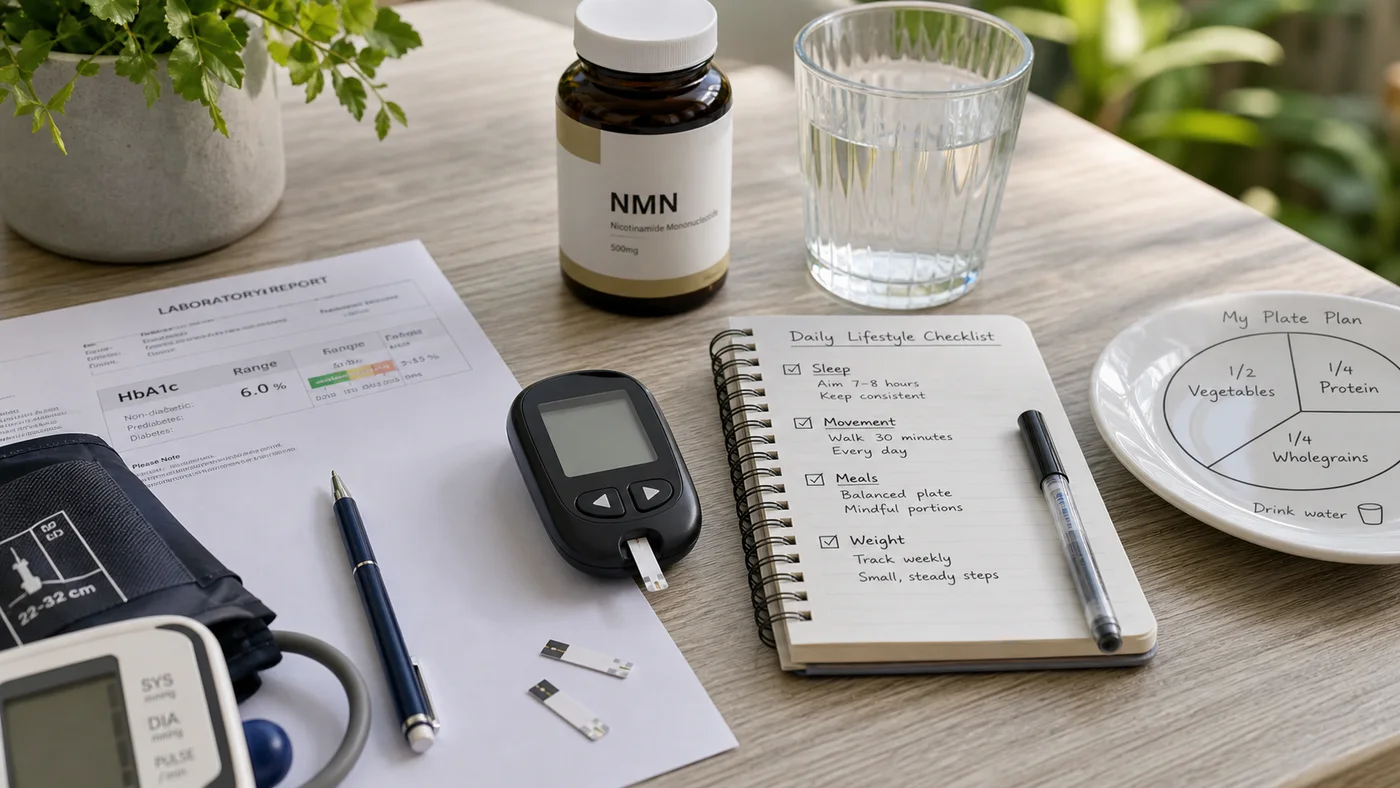
If you sit at a routine medical check-up in Bangsar or Penang and the doctor circles a fasting glucose of 6.2 mmol/L or an HbA1c of 6.0 percent, you are already in this group.
What makes the Malaysian picture distinct is the combination of dietary load and ethnic-phenotype risk. White rice as a daily three-meal staple, kopi-O kaw with condensed milk, mamak roti canai breakfasts, and the ubiquity of sugary sweetened drinks all push glycaemic load higher than the typical Mediterranean comparator.
Layer on the Asian metabolic phenotype - South-East Asian adults develop insulin resistance at lower BMI thresholds than European populations - and the pancreas is under load earlier in life.
Sedentary office work in Klang Valley high-rises, motor-vehicle dependence, and the cultural difficulty of declining a third helping at a family dinner all reinforce the trajectory. By the time most Malaysians notice the diagnosis, the disease has been brewing quietly for five to ten years.
This is the window where intervention pays the largest dividend, and it is the window where adults start asking whether NMN belongs on the kitchen counter next to the metformin and the multivitamin.
How NAD+ biology connects to insulin sensitivity
Nicotinamide Mononucleotide is a precursor that the body converts to NAD+, a cofactor used in hundreds of enzymatic reactions including the sirtuin family. SIRT1 in particular regulates mitochondrial biogenesis and modulates insulin-receptor signalling in skeletal muscle and the liver.
Gomes et al. (2013) documented the age-related decline in tissue NAD+ and tied it to reduced communication between the nucleus and mitochondria, producing what they called a pseudo-hypoxic metabolic state in older mice.
Rajman et al. (2018) reviewed the broader sirtuin-activator landscape and emphasised the same point: raising NAD+ pharmacologically restores some of the metabolic flexibility that is lost with age. The plausible mechanism for prediabetes is that increased NAD+ availability supports SIRT1-mediated improvements in muscle insulin signalling, hepatic gluconeogenesis control and mitochondrial fatty-acid oxidation.
The mechanism is well-described. The clinical effect size in humans is what remains modest.
Yoshino 2021 in detail: the trial Malaysian patients should know
The Yoshino et al. (2021) paper, published in Science, is the single most relevant human trial for any prediabetic Malaysian considering NMN. The design matters because dosing recommendations rest on it.
Population: 25 postmenopausal women aged 55 to 75, BMI between 25.0 and 32.4 kg/m squared, with prediabetes defined by a fasting glucose of 5.6-6.9 mmol/L or an oral-glucose-tolerance test in the impaired range. None had diagnosed diabetes, none were on insulin or sulfonylureas.
Intervention: Oral NMN 250mg once daily versus placebo, parallel-group, double-blind, for ten consecutive weeks. The dose was selected on the basis of earlier safety pharmacokinetic work by Irie et al. (2020) demonstrating tolerability up to 500mg single doses.
Primary outcome: Insulin-stimulated muscle glucose disposal measured via the gold-standard hyperinsulinaemic-euglycaemic clamp, with skeletal-muscle biopsies taken before and after the intervention to examine intracellular insulin-signalling proteins.
What improved: Muscle insulin sensitivity rose by roughly 25 percent in the NMN group, statistically significant against placebo. Phosphorylation of AKT and mTOR - two downstream insulin-signalling proteins - was elevated in the post-treatment biopsies. Muscle remodelling gene expression also shifted toward a more insulin-responsive profile.
What did not improve: Body weight, fat mass, blood pressure, fasting plasma glucose, fasting insulin, HbA1c and circulating lipids did not differ significantly between groups. This is the part patients regularly miss when reading the headline.
NMN improved a tissue-level marker of how muscle responds to insulin; it did not move the conventional clinic numbers a Malaysian GP relies on for diagnosis or follow-up.
Adverse events: None serious, none requiring discontinuation. Mild gastrointestinal symptoms were balanced between groups.
The trial is small, the population is narrow (postmenopausal women only, no men, no younger adults), and the duration is short. The signal is biological and real, but it is not yet a license to claim NMN reverses prediabetes.
Other supportive trials worth knowing
The Igarashi et al. (2022) trial in older Japanese men used the same 250mg/day dose for twelve weeks. It did not target prediabetes specifically, but the population was metabolically aged and at higher diabetes risk, and the trial reported small improvements in walking speed and grip strength alongside an acceptable safety profile.
It supports the general claim that 250mg/day is well-tolerated over three months in older East Asian men - a closer metabolic comparator than the postmenopausal-women population in Yoshino, though not identical to a typical Malaysian patient.
Mouse work - most notably the long-term feeding studies summarised by Rajman et al. (2018) - shows that NMN improves glucose tolerance, insulin sensitivity and mitochondrial function in aged animals. Mouse data does not translate one-to-one to humans, but it is part of the mechanistic background people bring into clinician discussions.
What does not yet exist is a randomised controlled trial of NMN against metformin head-to-head, a trial in Malaysian or broader South-East Asian prediabetic adults, or a hard-endpoint trial measuring progression to type 2 diabetes. Until those exist, every recommendation is interpolated from the available data.
The honest expectations conversation
If you are an adult Malaysian with prediabetes, the realistic upside of adding NMN to your routine is modest. The Yoshino effect size on muscle insulin sensitivity was meaningful but did not translate to improved HbA1c at ten weeks. Whether a longer course at the same or a higher dose would eventually shift HbA1c is a fair scientific question - and one no one has answered.
The interventions with the strongest evidence for reversing prediabetes are blunt and old-fashioned: a 5-7 percent reduction in body weight, replacement of refined-carbohydrate calories with vegetables, legumes and whole grains, daily walking of at least 30 minutes plus two resistance-training sessions weekly, and adequate sleep.
The Diabetes Prevention Program in the United States demonstrated a 58 percent reduction in progression to diabetes with a structured lifestyle programme - no supplement has come close.
If a lifestyle programme is in place and you still want to discuss a supplement layer, bring the published trial-dose context to your doctor or pharmacist. If lifestyle change has not started, spending RM 200 a month on NMN before walking shoes and a kitchen overhaul is poor allocation of effort.
Drug interactions and metformin compatibility
The most common pharmacological situation a Malaysian prediabetic patient faces is metformin. Many GPs at Klinik Kesihatan or in private practice now start metformin during the prediabetic window, especially when HbA1c sits above 6.0 percent or BMI is above 27.
Metformin works through AMPK activation and mild inhibition of hepatic gluconeogenesis. It does not share the same enzymatic targets as NMN, and there is no documented pharmacokinetic interaction.
In practice, many patients take both. Inform your prescriber, continue metformin at the prescribed dose, do not interpret NMN as a reason to reduce or skip metformin, and keep to whatever HbA1c review schedule your doctor sets.
If you are on insulin or a sulfonylurea such as gliclazide, the question becomes more delicate - these agents carry hypoglycaemia risk, and any improvement in insulin sensitivity from NMN could in theory amplify it. This is a conversation for your endocrinologist, who may want more frequent fingerprick monitoring in the first month.
Statins, ACE inhibitors and antihypertensives do not interact with NMN in any documented sense. SGLT2 inhibitors and GLP-1 agonists similarly have no known interaction.
The agents to be most cautious with are anticoagulants and antiplatelets - not because of a specific interaction, but because of a theoretical concern around bleeding time at high NAD+ states. On surgery generally, some clinicians advise pausing supplements beforehand; ask your doctor and surgeon how far in advance, rather than relying on a fixed number.
Monitoring: questions to bring to your Malaysian doctor
Monitoring is something to agree with your GP or Klinik Kesihatan doctor rather than self-schedule. The questions worth raising look like this:
Before starting anything: Ask whether a baseline is worth recording - HbA1c, fasting plasma glucose, a full lipid panel, liver function tests, and waist circumference - alongside your current weight, blood pressure and medication list. A simple three-day food diary is often more informative than patients expect, and it costs nothing to bring.
How they would track change: Ask how often they would repeat HbA1c, fasting glucose and lipids, and what movement would reassure or concern them. A common framing doctors use is that an HbA1c rising rather than improving is a signal to step back and reassess - including whether to stop the supplement and look harder at lifestyle adherence.
Over the longer term: Ask how a resting blood-pressure reading, body composition where available, and a waist measurement fit in, and how often medication need should be reassessed.
The Klinik Kesihatan network provides HbA1c testing at low cost, and most private GP clinics offer it for between RM 30 and RM 60. Consistency of measurement, agreed with your doctor, matters more than any fixed interval an article could give you.
Coordination with your Malaysian doctor
The single most useful thing you can do is bring the supplement bottle to your next clinic appointment. GPs at IMU-affiliated clinics, Subang Jaya Medical Centre, Pantai, Sunway Medical and Gleneagles all increasingly see patients on NMN, and the response is generally pragmatic rather than dismissive.
Ask three questions: is anything in my current medication list flagged as interacting; should we add a baseline liver function test if I am layering several supplements; and how often should we check HbA1c during this trial.
Bring the published dose context - Yoshino 2021, 250mg/day, 10 weeks - rather than a marketing leaflet. Doctors respond to trial citations. Most will document the supplement question in your record and resume normal monitoring.
Cost-effectiveness over a long horizon
A monthly outlay of RM 150 to RM 250 over a decade is between RM 18,000 and RM 30,000. The cost of a single year of insulin therapy plus complications screening at a private hospital easily exceeds RM 10,000, and the disability-adjusted cost of advanced diabetic complications - neuropathy, retinopathy, foot ulcers, nephropathy - is substantially higher.
A lifestyle intervention that successfully prevents progression is the highest-return decision available. NMN as a small adjunct may add a fraction of a percent to the prevention probability; it cannot substitute for the lifestyle programme that does the heavy lifting.
The honest framing for a Malaysian buyer is: this is a discretionary supplement with a real but modest mechanistic basis, not a medication, and not a replacement for diet, exercise or any prescribed therapy.
Halal status and the Malaysian Muslim patient
The NMN molecule itself is produced through microbial fermentation, not from animal sources, so the active ingredient raises no halal concerns by composition. The complications sit in the capsule shell and the manufacturing line.
Gelatin capsules derived from porcine or non-zabihah bovine sources are not halal. Most halal-conscious Malaysian retailers therefore favour HPMC (hydroxypropyl methylcellulose) vegetable capsules.
JAKIM-recognised halal certification on the finished product offers the strongest assurance, though it remains uncommon for imported NMN brands. A JAKIM-recognised certifier from the country of origin (such as MUI in Indonesia or JAKIM-listed bodies elsewhere) is acceptable.
If formal certification is unavailable, a manufacturer letter confirming vegetable capsule shells, no animal-derived excipients, and no shared production line with non-halal products is a reasonable interim assurance. Several Malaysian brands now publish this letter on their product pages.
Who should not take NMN
There are a small number of situations where the answer is clearly no, even with prediabetes as an indication. Pregnant or breastfeeding women should not take NMN because no trial data exists in this population.
Patients with active malignancy should consult their oncologist before any NAD+ precursor - the underlying pathway is mechanistically active in many cancers. Children and adolescents have no trial data and should not take NMN.
Patients on insulin or sulfonylureas should not start without endocrinologist input because of theoretical hypoglycaemia risk. Anyone with a planned surgery should ask their doctor and surgeon whether and how far in advance to pause supplements. Anyone with abnormal liver function tests should investigate the cause before adding any new supplement.
When to discontinue
Bring these situations to your doctor, who can advise whether to stop: an HbA1c trending upward across consecutive readings despite adherence, persistent gastrointestinal symptoms beyond the first two weeks, an unexplained rise in liver enzymes, the need to start insulin or a sulfonylurea, the start of a planned pregnancy, or the diagnosis of a malignancy.
None of these are emergencies in the supplement itself; they are signals to reassess priorities with a clinician rather than to act on alone.
Discontinuation does not produce any withdrawal pattern. Stopping the daily capsule has no documented rebound effect. The body simply returns to its baseline NAD+ trajectory.
The bottom line for a Malaysian buyer
If you are a prediabetic Malaysian adult - and statistically, roughly one in four readers of this page is - the order of operations is unchanged. Diet first, weight loss next, exercise third, sleep and stress management fourth, prescribed medication if your doctor advises, and only then a discretionary supplement layer.
Within that supplement layer, the dose with the most published evidence is the 250mg/day taken in the morning in the Yoshino 2021 trial - that is study context to bring to a doctor, not a regimen this page is prescribing for you. The expected benefit is biological rather than dramatic, and the cost is non-trivial.
If you choose to buy, prefer a brand with third-party Certificate of Analysis documentation and a vegetable-capsule formulation, and store the bottle away from heat and humidity.
Decide alongside your doctor whether NMN suits you and how your HbA1c should be tracked, and treat it as one small input in a larger metabolic strategy. That is the honest position the published evidence supports today.
Related conditions
- Type 2 Diabetes - Type 2 diabetes is a chronic condition where the body becomes resistant to insulin and blood glucose...
- Metabolic Syndrome - Metabolic syndrome is a cluster of conditions including central obesity, high blood pressure, dyslip...
- Insulin Resistance - Insulin resistance is when muscle, fat and liver cells respond poorly to insulin, forcing the pancre...
- Obesity - Obesity is excess body fat that raises the risk of diabetes, heart disease, joint problems and certa...